





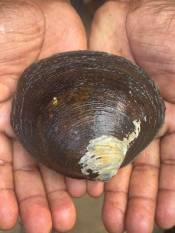


KOCHI, 9 February 2026: In a significant scientific breakthrough for marine conservation and sustainable aquaculture, the ICAR–Central Marine Fisheries Research Institute (CMFRI) has successfully achieved induced breeding of the mangrove clam (Geloina erosa) under captive conditions — a milestone expected to aid the restoration of this declining bivalve species while supporting estuarine livelihoods.
Commonly known as mud clams and locally called ‘Kandal Kakka’, mangrove clams are a vital component of estuarine and mangrove ecosystems across South and Southeast Asia. Despite their ecological and nutritional importance, wild stocks have dwindled sharply in recent years due to indiscriminate harvesting, habitat loss, pollution, and coastal development.
Scientists from CMFRI’s Mariculture Division induced spawning in captive broodstock and successfully completed full embryonic and larval development under controlled conditions. The team recorded successful spat settlement on the 18th day after spawning — marking one of the very few documented global instances of hatchery-based breeding, larval rearing, and spat production for this species.
Researchers are now working to standardise larval rearing and nursery management protocols to improve survival rates and enable large-scale seed production. According to CMFRI scientists, hatchery-produced seeds can be used for ranching in mangrove ecosystems and for low-input farming in estuarine waters, helping replenish depleted stocks while reducing pressure on natural populations.
“This development integrates conservation with livelihood generation,” scientists noted, adding that community-managed aquaculture of mangrove clams could provide sustainable income and nutritional security to mangrove-dependent communities, particularly in Kerala.
The species plays a crucial ecological role by recycling nutrients, stabilising sediments, and supporting biodiversity. Considered among the largest mud clams globally — with shells reaching up to 10 cm — it remains a valued local delicacy, especially in northern Kerala.
However, the absence of scientific stock assessments, size regulations, and seasonal fishing restrictions has worsened the decline, with noticeable reductions in both abundance and shell size along India’s east coast and island regions.
CMFRI believes that the new hatchery technology, combined with habitat restoration and regulated harvesting, can help reverse the decline of this threatened resource. The breakthrough is expected to open new avenues for sustainable aquaculture, ecosystem restoration, and resilient coastal livelihoods.
Photo caption: Mangrove clam (Geloina erosa)