





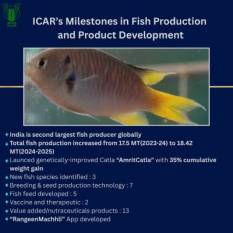


NEW DELHI, 16 July 2025: India’s fisheries sector is witnessing unprecedented growth, with total fish production reaching 18.42 million tonnes in 2024-25, up from 17.5 million tonnes the previous year.
The Indian Council of Agricultural Research (ICAR) has played a pivotal role in driving this progress through cutting-edge research, genetic innovation, and technology deployment across the aquaculture value chain.
India is now firmly positioned as the second-largest fish producer globally, thanks to sustained government efforts, farmer participation, and research-backed innovations.
Genetically Improved “AmritCatla” Drives Productivity
One of ICAR’s standout achievements this year is the launch of “AmritCatla”, a genetically improved variant of the Indian major carp Catla. This new breed delivers a 35% cumulative weight gain, enabling faster growth cycles, reduced production costs, and higher profitability for fish farmers. It is expected to make a significant impact in freshwater aquaculture, particularly in eastern and southern states.
Science-Backed Growth Across the Value Chain
ICAR has also reported a series of breakthroughs that span the entire aquaculture production ecosystem:
- Three new fish species identified for commercial aquaculture.
- Seven new technologies in breeding and seed production, improving hatchery efficiency and stock quality.
- Five advanced fish feeds formulated to enhance nutrient absorption and lower environmental impact.
- Two novel vaccines and therapeutics developed to combat common aquaculture diseases.
Thirteen value-added and nutraceutical products introduced, aimed at both domestic consumption and export markets, including omega-rich supplements and functional food ingredients.
Empowering Farmers Through Digital Tools
To bring these innovations directly to farmers, ICAR has launched the “RangeenMachhli” mobile application, a multilingual platform designed to disseminate real-time information on species management, disease control, market trends, and best practices. The app is part of ICAR’s broader strategy to digitally empower small-scale fishers and enhance last-mile delivery of technology.
A Strategic Sector for India’s Blue Economy
The fisheries sector supports over 28 million livelihoods in India, contributing to nutritional security, rural employment, and foreign exchange earnings. As per estimates, India exported over USD 8 billion worth of marine products in 2023–24.
ICAR’s latest achievements align with the Government of India’s Blue Revolution and Matsya Sampada Yojana, which aim to double fish production and improve sectoral sustainability. These efforts are also closely linked to India’s commitments under the UN Sustainable Development Goals (SDG-14: Life Below Water).
Dr. Himanshu Pathak, Director General of ICAR, said, “Our goal is not just to boost production but to build a resilient and inclusive fisheries sector. Through innovations like AmritCatla and digital tools like RangeenMachhli, we are empowering farmers with science, knowledge, and opportunity.”
As India moves toward becoming a global aquaculture leader, ICAR’s latest milestones mark a significant step in transforming fish farming into a high-value, climate-resilient, and tech-driven enterprise.