





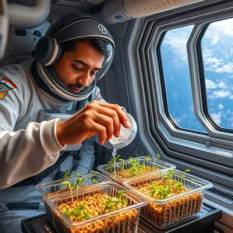


DHARWAD, 27 June 2025: In a pioneering step for Indian space agriculture, the University of Agricultural Sciences (UAS), Bangalore, and the Indian Institute of Technology (IIT), Dharwad, have sent green gram and fenugreek seeds to the International Space Station (ISS) aboard the Axiom-4 research mission launched on Wednesday.
The 25 grams of seeds — divided between the two varieties — will be sprouted in microgravity on the ISS, while identical seeds are being grown under the same conditions at the UAS Bangalore campus to enable comparative analysis.
ISRO astronaut Shubhanshu Shukla will water and monitor the seeds in space, and bring the sprouted samples back to India for further study. According to UAS Vice-Chancellor PL Patil, this experiment will play a key role in developing fresh, nutritious salad vegetables for astronauts on long-duration missions.
“Sprouted green gram and fenugreek can support astronauts by boosting immunity, and managing bone, kidney, and heart health while reducing the need to carry packaged food,” Patil explained.
The mission’s Principal Investigator is Dr. Ravikumar Hosamani, Assistant Professor in the Department of Biotechnology at UAS, with Co-Investigator Dr. Sudheer Siddapureddy from IIT Dharwad.
Between June 8 and 11, experts from both institutions traveled to the Kennedy Space Center in Florida to hand over the seeds, packed in 12 containers, each holding around four grams.
Sprouting seeds in space is seen as a practical solution for future long-term missions, as fresh salad crops — such as lettuce, radish, cabbage, and onions — can be hand-harvested and consumed directly, supplementing packaged food with essential nutrients.
Growing fully mature plants in orbit, however, presents challenges in maintaining controlled conditions like programmable lighting, temperature, humidity, CO2, and nutrient delivery systems.
The researchers note that space agriculture focused on Indian astronauts is vital, considering their distinct dietary habits and genetic backgrounds compared to Western space crews.
As India advances toward its own human spaceflight capabilities, this research aims to ensure that future astronauts can benefit from fresh, homegrown, and culturally appropriate foods in space.