





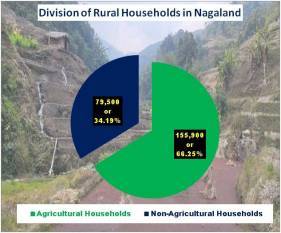


KOHIMA, 23 June 2025: Agriculture remains the cornerstone of rural life in Nagaland, with new data revealing that 66.25% of the state’s rural households are engaged in farming, according to the 77th Round of the National Sample Survey (NSS).
Out of approximately 2.35 lakh rural households, about 1.56 lakh are classified as agricultural households, while roughly 79,500 depend on non-agricultural occupations. The survey was conducted from January to December 2019 and includes significant insights into land distribution, cultivation practices, and household profiles.
A notable finding was the overwhelming dominance of small and marginal landholdings. Nearly 74% of rural households operate on less than 1 hectare of land. Among them, 33.19% own just 0.01–0.40 ha, and 40.63% own 0.40–1.00 ha, highlighting widespread land fragmentation that limits large-scale or mechanized agriculture.
Jhum cultivation, or shifting agriculture, remains a defining feature of the state's agrarian landscape. According to the report, around 40% of the total operational land area is still under jhum, especially among small landholders. Non-agricultural land use—including housing, fallow land, and infrastructure—accounts for another 27.5% of the total.
The survey also explored the distribution of households across social groups. Scheduled Tribes (STs) comprise 97.24% of rural households, of which 66.96% engage in agriculture. In contrast, Scheduled Castes (SCs), with just 1.74% of the rural population, showed only 17.07% agricultural participation, indicating heavier reliance on non-farming livelihoods.
Other Backward Classes (OBCs), though few in number, showed the highest agricultural participation rate at 83.34%, with 2,000 out of 2,400 households involved in farming.
Land ownership patterns revealed that marginal holdings below 0.01 ha were extremely rare, with just 500 households falling in this category. Holdings above 2 hectares were also uncommon—only 5.3% of households owned between 2.01 and 4 hectares, while less than 0.2% had holdings above 4 ha, and none reported landholdings exceeding 10 hectares.
Despite the notion of strong private landownership in the state, the percentage distribution points to a curious paradox: widespread private holdings exist but are primarily small-scale, leaving many households economically vulnerable and reliant on subsistence farming.
Mixed land use—where farming is combined with livestock or fisheries—was most prevalent among semi-medium landholders, while medium holdings (4–10 ha) showed an even split between agricultural and non-agricultural purposes.
The NSS defined an agricultural household as one with at least one member self-employed in farming in the last 365 days, with agricultural output exceeding ₹4,000. The data excludes households reliant solely on artisan work, forest product gathering, or rural services.
Conducted in two rounds, the survey covered the agricultural year 2018–19, with estimates reflecting household status at the survey's midpoint. Weighted averages were used to derive state-level indicators.
The findings underscore Nagaland’s continued dependence on agriculture, particularly among tribal communities. However, the fragmented landholding pattern, reliance on jhum, and limited access to larger plots suggest the need for policy innovation and support systems to enhance productivity and economic security for smallholder farmers.
As the state looks to modernize agriculture and promote sustainable livelihoods, this data offers valuable insight into where resources and reforms should be targeted.
Image credit: morungexpress.com