





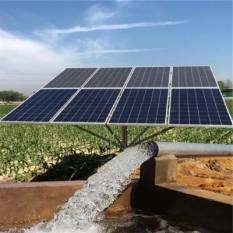


GANDHINAGAR, 12 July 2025: India’s agricultural sector, employing over 45% of the country’s workforce and contributing nearly one-fifth to the national GDP, is undergoing a silent revolution — one powered by the sun. In a landmark shift towards climate-resilient and cost-effective irrigation, solar-powered pumps are replacing diesel engines across farmlands, marking a critical transition in India’s agrarian energy model.
For decades, farmers in India have depended on diesel-fuelled pumps for irrigation, incurring high operational costs while contributing to substantial carbon emissions. The unreliable nature of power supply in rural areas has further complicated agricultural productivity. With 250–300 sunny days annually, the country’s solar potential offers a viable alternative — one that ensures energy independence and economic relief for farmers.
PM-KUSUM: A Policy Push for Solar Upliftment
The government’s flagship Pradhan Mantri Kisan Urja Suraksha evam Utthaan Mahabhiyan (PM-KUSUM) scheme, launched in 2019, aims to reduce initial adoption costs of solar pumps through up to 60% subsidy support and low-interest loans. By 2026, the scheme envisions the deployment of 1.4 million standalone solar pumps and 3.5 million grid-connected pumps, potentially benefiting 2.75 million hectares of agricultural land.
In addition to replacing diesel, Component C of PM-KUSUM allows farmers with grid-connected solar pumps to export surplus energy, earning up to ₹50,000 annually — transforming them from Annadatas (food providers) to Urjadatas (energy producers).
Financial and Environmental Gains
Solar irrigation not only eliminates fuel dependency, but also promotes micro-irrigation techniques that improve water-use efficiency and crop yields. According to estimates, a 3 HP off-grid solar pump costing ₹1.5 lakh can save equivalent amounts in DISCOM investments, and an additional ₹59,290 annually in energy expenses.
With over 30 million irrigation pumps in India, including 8.5 million diesel pumps, the transition to solar is both an economic imperative and an environmental necessity. The move eases pressure on distribution companies (DISCOMs), reduces carbon emissions, and supports India’s commitment to achieving 500 GW of non-fossil fuel capacity by 2030.
From Risk to Resilience
The wider use of solar energy is catalysing a broader transformation in rural India. Farmers are increasingly reinvesting their energy savings into improved inputs, crop diversification, and infrastructure expansion. As rural households evolve from passive consumers to energy contributors, they are driving a bottom-up clean energy revolution with significant long-term impact on India’s climate goals, rural livelihoods, and national food security.