







Key marine species show changes in size, maturity, and migration patterns; experts call for urgent climate mitigation, adaptive strategies
KOCHI, 5 August 2025: Marine scientists have raised serious concerns over the growing impact of climate change on India’s marine ecosystems and fisheries, citing evidence of biological shifts in key species, changing distribution patterns, and increased vulnerability of coastal communities.
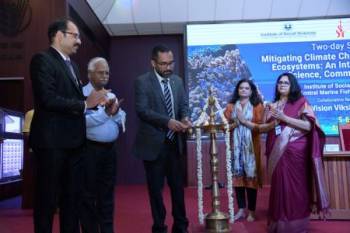
Speaking at a two-day national seminar on “Mitigating Climate Change Impact on Marine Ecosystems,” jointly organised by ICAR–Central Marine Fisheries Research Institute (CMFRI) and the Institute of Social Sciences, New Delhi, experts stressed the need for urgent policy action, ecosystem restoration, and climate-resilient fisheries management. The event was supported by the Indian Council of Social Science Research (ICSSR).
Smaller Fish, Lower Fecundity
Delivering the keynote address, Dr Grinson George, Director of CMFRI, highlighted alarming changes in the phenology—the life cycle patterns—of commercially important marine species.
“Species like silver pomfret are now maturing at significantly smaller sizes—280g compared to 410g earlier,” he said. “This trend is mirrored in prawns, sardines, and mackerels, impacting reproductive success and recruitment into fisheries.”
He also pointed to geographical shifts in fish stocks, with species such as the Indian oil sardine migrating northwards, driven by changes in rainfall patterns, food availability, oceanic upwelling, and oxygen levels.
“Climate-induced events like cyclones are reducing the number of fishing days annually, affecting livelihoods and food security,” Dr George added.
Coral Bleaching and Coastal Threats
Dr K R Sreenath, Director of the Fishery Survey of India, who inaugurated the seminar, drew attention to coral reef bleaching in Lakshadweep, which poses a major threat to marine biodiversity and coastal protection.
He also raised concerns about US-imposed reciprocal tariffs on seafood, which are pushing Indian fishers into economic precarity.
He called for community-based policy frameworks and accurate predictive models for both weather events and species distribution.
“These are crucial for disaster risk reduction and sustainable fisheries planning,” he said.
Lakshadweep Ecosystem Under Pressure
Dr K Mohammed Koya, Fisheries Development Commissioner, Government of India, said that climate change has drastically altered the Lakshadweep marine ecosystem.
“Seagrass beds have suffered damage, impacting fisheries,” he said. “We must invest in restoration and explore alternatives like seaweed farming, which supports biodiversity and livelihoods.”
He also highlighted the potential of India’s carbon market system to incentivize sustainable practices among fishers and aquaculture farmers.
Cyclones, Saltwater Intrusion, and Health Risks
Prof. Vinod Sharma, Climate Change Advisor to the Government of Sikkim, emphasized that since 2000, shoreline changes and saltwater intrusion have accelerated, especially in areas bordering the Arabian Sea.
“The increased frequency of cyclones is degrading freshwater sources and impacting the health of coastal communities,” Prof. Sharma noted.
Seminar Focus Areas and Way Forward
Dr Surajit Mahalanobis, Senior Research Fellow at the Institute of Social Sciences, presented an overview of the seminar.
Other speakers included Dr Shoba Joe Kizhakudan and Dr Pooja Sharma, who underscored the importance of interdisciplinary and community-inclusive strategies to address the climate-fisheries nexus.
The seminar, which concludes on Wednesday, is addressing themes such as:
- Adaptive management strategies for fisheries
- Socio-economic resilience of coastal communities
- Nature-based solutions and blue carbon restoration
- Role of innovation and emerging technologies in climate adaptation