





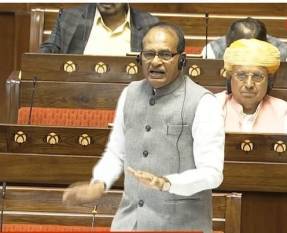


NEW DELHI, 23 February 2026: Union Agriculture & Farmers’ Welfare Minister Shivraj Singh Chouhan asserts in the Rajya Sabha that infrastructure worth over INR 1 lakh crore created under the Agriculture Infrastructure Fund (AIF) is driving a “field-to-farm revolution” across the country.
Replying to Members of Parliament, he states that the government led by Prime Minister Narendra Modi is committed not to power for its own sake, but to farmer welfare, rural prosperity and a self-reliant India.
‘Farmer Is Jeevandata, Not Just Annadata’
Chouhan describes farmers as “jeevandata” (life givers), saying they are “not God, but certainly no less than God.” He contrasts what he terms five decades of neglect under previous Congress governments with the current administration’s focus on storage, irrigation, procurement and technology-driven reforms.
He says Prime Minister Modi identified the lack of post-harvest infrastructure as a structural weakness in Indian agriculture and responded with the INR 1 lakh crore Agriculture Infrastructure Fund to reduce losses and strengthen value chains.
Massive Infra Push Under AIF
Under AIF, the government has established:
- 44,243 Custom Hiring Centres
- 25,854 Primary Processing Centres
- 25,565 Farm Harvest Automation Units
- 17,779 Warehouses
- 4,201 Sorting and Grading Units
- 3,549 Smart & Precision Agriculture infrastructure units
- 2,827 Cold Storages
According to the Minister, these facilities have reduced post-harvest losses of crops, fruits and vegetables by 5–15%, allowing farmers to store produce and sell at better prices rather than distress-selling immediately after harvest.
He highlights Punjab’s performance, where projects worth over INR 11,351 crore have been approved against an initial target of INR 7,425 crore, generating employment and strengthening rural infrastructure.
MSP and Pulses Procurement at Record Levels
On Minimum Support Price (MSP), Chouhan criticises the opposition, claiming earlier governments rejected the Swaminathan Commission’s recommendation of 50% profit over cost. He states the current government implemented MSP at 50?ove cost and ensured greater procurement.
He says pulses procurement under the Modi government has reached 1.92 crore metric tonnes compared to 6 lakh metric tonnes during the previous 10-year UPA period.
The Minister announces 100% procurement of tur, urad and masoor, assuring farmers that whatever quantity they produce and bring to mandis will be purchased. Procurement is being undertaken through agencies such as National Agricultural Cooperative Marketing Federation of India Ltd (NAFED) and National Cooperative Consumers' Federation of India Ltd (NCCF), with payments transferred directly to farmers via Direct Benefit Transfer.
Self-Reliance in Pulses by 2030–31
Chouhan outlines the Self-Reliance in Pulses Mission aimed at making India fully self-sufficient by 2030–31. He notes that while India accounts for 38% of global pulses acreage, its production share was only 28% due to low productivity.
Through improved seed varieties, higher seed replacement rates, cluster demonstrations, free mini-kits, INR 10,000 per hectare assistance and support up to INR 25 lakh for dal mills, production has surged. Pulses output reached a record 27.30 million tonnes in 2021–22, marking what he calls a “pulses revolution.”
Stubble Burning: Solution, Not Blame
Addressing pollution concerns, Chouhan says farmers should not be solely blamed for stubble burning. Under the Crop Residue Management scheme, 50% subsidy is provided for machines and 80% for Custom Hiring Centres.
More than 3.5 lakh machines have been distributed across Punjab, Haryana, Uttar Pradesh and Madhya Pradesh. Pellet plants and biomass initiatives are converting paddy straw into energy resources, including bio-CNG and industrial fuel.
He praises Haryana’s incentive model for crop diversification and residue management, terming it an example of solution-oriented governance.
Crop Diversification and Water Security
While stating India has achieved self-reliance in wheat and rice and become the world’s largest rice producer at 15 crore tonnes, the Minister emphasises the need for balanced food, water and energy security.
Direct Seeded Rice (DSR) and less water-intensive varieties are being promoted. Financial assistance is being provided for pulses, maize, barley and nutritious cereals to encourage diversification in Punjab, Haryana and western Uttar Pradesh.
Farmer as Urjadata
Chouhan concludes that initiatives like AIF, MSP reforms, the Pulses Mission, PM-KUSUM and rural infrastructure programmes are transforming the farmer from merely an “annadata” into an “urjadata” (energy provider).
He reiterates that infrastructure creation, assured procurement and controlled imports are collectively strengthening India’s march toward Atmanirbhar Bharat.