





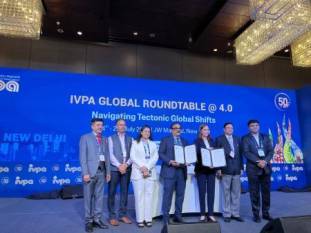


MUMBAI, 28 July 2025: Malaysia has expanded its share in India's palm oil import market to 35% in the first half of 2025, up from 30% in 2023, driven by competitive pricing, strong festive demand, and recent import duty adjustments.
The development was announced during the IVPA Global RoundTable @ 4.0, where the Malaysian Palm Oil Council (MPOC) reaffirmed its long-term commitment to India’s edible oil security and sustainability goals.
Speaking at the RoundTable, themed “Navigating Trade, Tariffs and Trust: Positioning Malaysian Palm Oil for the Indian Market”, MPOC CEO Ms. Belvinder Sron highlighted that Malaysia has consistently exported an average of 2.5 million metric tonnes (MT) of crude palm oil (CPO) to India annually over the past five years.
“Our monthly exports to India rebounded to 2.5 lakh MT in May and June 2025, following a brief post-October slowdown. With the recent duty cut implemented in July, Malaysian CPO is now the most competitively priced edible oil in India. We expect continued momentum heading into the festive season,” she said.
Competitive Edge and Tariff Boost
Malaysia’s palm oil industry has gained a significant edge following the Indian government's mid-year revision of import duties. The revised tariff structure has positioned Malaysian CPO as the most cost-effective edible oil option in the Indian market, reinforcing its appeal among refiners and bulk buyers.
MPOC also signed a formal collaboration with the Indian Vegetable Oil Producers’ Association (IVPA) during the event, aimed at strengthening the positioning of Malaysian palm oil based on its nutritional profile and sustainability standards.
Strong Supply Base, Sustainable Credentials
With a 24% share of global palm oil production and an output of 19.34 million MT in 2024, Malaysia remains the world’s second-largest palm oil producer. The country exports the majority of its palm oil while consuming just 3–3.5 million MT domestically.
While total output peaked at 19.9 million MT in 2017, land expansion has since plateaued, in alignment with Malaysia’s environmental commitments. Instead, the sector has focused on improving productivity and sustainability through innovation, smallholder inclusion, and strict certification protocols.
Central to these efforts is the Malaysian Sustainable Palm Oil (MSPO) certification, which is legally mandated and independently audited. As of 2025, about 90% of Malaysian palm oil plantations are MSPO-certified. The upgraded MSPO 2.0, effective since January 2025, introduces more rigorous sustainability and ethical standards across the supply chain.
Ms. Sron noted that government support has been instrumental in making MSPO adoption accessible, especially for smallholders, while R&D continues to drive yield improvements and reduce environmental impact.
Strategic Engagement with India
India has remained a cornerstone of Malaysia’s global palm oil trade for over three decades. Since opening its second regional office globally in India in 1995, MPOC has engaged closely with Indian policymakers, refiners, researchers, and trade bodies to bolster bilateral agri-trade relations.
In March 2025, MPOC signed a collaboration agreement with the Oil Technologists’ Association of India (OTAI) to support scientific research and nutritional education on palm oil. The initiative also aims to counter misinformation, including misleading “No Palm Oil” labelling, through evidence-based public awareness.
Looking ahead, MPOC plans to deepen its engagement with Indian stakeholders to promote responsibly sourced, traceable palm oil, while highlighting its role in meeting India’s rising demand for affordable, versatile edible oils.