





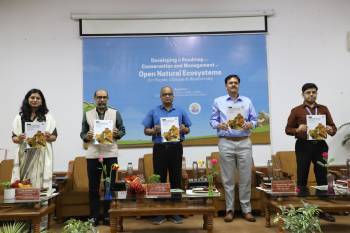


Released a policy brief ‘Sands and Grasses of ‘Gold’: Valuing Rajasthan’s Open Natural Ecosystems for People, Climate and Biodiversity’
JODHPUR, 17 September 2025: The Centre for Policy Design (CPD) at the Ashoka Trust for Research in Ecology and the Environment (ATREE), in collaboration with Indian Council of Forestry Research and Education’s Arid Forest Research Institute (ICFRE-AFRI), convened a state-level consultation in Jodhpur to chart a roadmap for the sustainable management of Open Natural Ecosystems (ONEs).
The consultation, held at the (ICFRE-AFRI) in Jodhpur, brought together senior representatives from various government institutes and departments, including the Indian Council of Forestry Research and Education (ICFRE), Indian Council of Agricultural Research- Central Arid Zone Research Institute (ICAR-CAZRI), Rajasthan Forest Department, Jodhpur Division, and Botanical Survey of India. Representatives of several key grassroots and civil society organisations such as the Desert Resource Centre, Camel Charisma, Foundation for Ecological Security, BNHS as well as community members from the “Oran Bachao” movement and pastoralists were also part of the consultation.
At the consultation, CPD-ATREE released its policy brief “Sands and Grasses of ‘Gold’: Valuing Rajasthan’s Open Natural Ecosystems for People, Climate and Biodiversity.” The brief highlights the ecological, economic, and cultural importance of Rajasthan’s deserts and grasslands, which include Orans and grazing lands critical for fodder security, biodiversity, and climate adaptation.
Why Rajasthan's Open Narutal Ecosystems (ONEs) matter
Despite their importance, ONE which include grasslands, deserts, shrublands, and rocky outcrops cover nearly 34% of Rajasthan (largest in India), yet remain under-acknowledged in existing land-use and policy frameworks, leaving them vulnerable to land conversion, degradation, and fragmented governance. Policies for their protection can safeguard India’s biodiversity while securing industries such as livestock, dairy, wool, meat, renewable energy, and tourism, which drive the country’s economy.
Policies for their protection can safeguard India’s biodiversity while also securing the economy. The state’s deserts and grasslands sustain its vast livestock sector, making Rajasthan the second-highest milk producer and one of the largest wool producer in the country, while also supporting industries such as meat, renewable energy, and tourism. Additionally, Rajasthan is the last stronghold for several endangered species, including the Great Indian Bustard, Indian Wolf, Blackbuck, and Chinkara, which are predominantly found in this region
The Chief Guest of the workshop was Dr. Suman Vyas, Director, CAZRI. In his keynote address, Dr. Vyas described the Thar Desert as a progressive ecosystem and said that the damage caused to open ecosystems by economic activities can be mitigated only through the conservation and proper development of livestock, pastures, and Oran-Gauchar areas.
Dr. Ashutosh Kumar Tripathi, Director of AFRI, in his presidential address, said that through everyone’s cooperation, dialogue, and responsibility in this workshop, the path for the sustainable development of open ecosystems will be paved.
Dr. Abi Tamin Vanak, Director, Centre for Policy Design, ATREE, while describing Rajasthan’s open natural ecosystems as vibrant and crucial for livelihoods, said that through integrated efforts for biodiversity and livelihood conservation as well as capacity building, it is possible to mitigate the adverse impacts of climate change.
Dr. Tarun Kant, Scientist-G and Program Coordinator, in his address, welcomed everyone and said that through this workshop, the desired goals for open ecosystems can be achieved through the collective efforts of various institutions and organizations.
In the technical session of the workshop, AFRI Scientist Mrs. Bhavana Sharma and subject experts from various fields – Dr. Chandan Singh (Botanical Survey of India), Dr. Sujit Narware (Bombay Natural History Society), Mohib Uddin (Wildlife Institute of India), Ilse Kohler-Rollefson (Camel Charisma Private Limited), Jugat Singh (Oran Bachao Andolan), Anshul Ojha (Desert Resource Centre), Sanjay Singh (ICFRE), Moti Urmul, Dimple were the eminent and diverse speakers.
The speakers emphasized the urgent need for cross-sectoral alignment between state and central agencies and inclusion of ONEs in official records for better management of these semi-arid landscapes. Key priorities identified included the co-development of a comprehensive roadmap for the conservation and management of ONEs in Western Rajasthan. Ultimately, the roadmap will advance livelihoods, fodder security, biodiversity, climate resilience, and sustainable land use, guided by inclusive, science- and community-led governance
The recommendations from the consultation will play a pivotal role in shaping sustainable land-use in Rajasthan, while also contributing to India’s larger climate and biodiversity commitments under Viksit Bharat. By recognizing and strengthening governance in these landscapes, Rajasthan’s deserts and grasslands remain a source of resilience and prosperity for generations to come.