





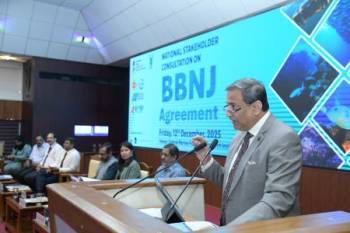


KOCHI, 15 December 2025: India has initiated work on a domestic framework to support the ratification and implementation of the High Seas Treaty, formally known as the Agreement on the Conservation and Sustainable Use of Marine Biological Diversity of Areas Beyond National Jurisdiction (BBNJ Agreement), ahead of its entry into force on 17 January 2026.
A national stakeholder consultation convened in Kochi by the Ministry of Earth Sciences (MoES), in collaboration with ICAR–Central Marine Fisheries Research Institute (CMFRI), the Centre for Marine Living Resources and Ecology (CMLRE), and multiple partners, assessed India’s preparedness to operationalise the treaty. The discussions focused on scientific, legal, and institutional mechanisms required for effective implementation.
Adopted under the United Nations Convention on the Law of the Sea (UNCLOS) in March 2023, the BBNJ Agreement is considered a landmark global instrument to conserve marine biodiversity in areas beyond national jurisdiction. To date, 145 countries, including India, have signed the agreement, while 76 have ratified it. Its entry into force is widely viewed as a turning point for global ocean governance amid rising pressures from climate change, overfishing, and marine pollution.
Legal experts and policymakers at the consultation highlighted the treaty’s role in addressing long-standing governance gaps related to marine genetic resources, environmental accountability, and equitable access to high seas biodiversity. Senior Advocate Sanjay Upadhyay noted that the agreement provides a structured framework to balance conservation objectives with national interests.
Scientific leaders emphasised India’s strong capabilities in ocean science and marine technology, urging closer integration of science, policy, and maritime law. CMFRI Director Grinson George underscored the treaty’s relevance to fisheries, noting that high seas activities directly influence fish stocks within India’s Exclusive Economic Zone.
Recommendations from the consultation will inform India’s domestic roadmap ahead of the first Conference of Parties scheduled for August 2026.