



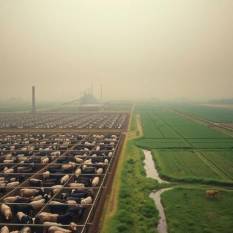


NEW YORK / US, 1 July 2025: Global banks sharply reduced funding for factory farming last year, but support for sustainable alternatives remains far behind, highlighting a persistent gap in green food system financing.
A new analysis from Stop Financing Factory Farming — a coalition of 25 climate, human rights and animal welfare groups — found that major multilateral finance institutions, including the World Bank Group and the European Investment Bank, cut their financial support for industrial animal agriculture by 46% in 2024. The total fell to $1.23 billion from $2.27 billion in 2023.
At the same time, investment in sustainable livestock practices more than tripled, from $77 million to $244 million. Yet these greener systems still received just one-fifth the funding of industrial-scale operations.
“Factory farming is destroying the planet and harming lives,” said Merel van der Mark of Sinergia Animal, a member of the coalition. “While finance institutions are shifting their investments, industrial animal agriculture still dominates spending by five to one.”
The analysis used data from the Early Warning System, which tracks project disclosures, and examined funding for meat and dairy production, including farms, slaughterhouses, feed mills, and vaccine manufacturers.
Overall, global meat and dairy investment fell by 31% in 2024, from $3.3 billion to $2.3 billion, according to the report. But the share of financing going to factory farming still rose, from 68% to 75%.
Among the lenders, the European Investment Bank saw the largest reduction in factory farming support, cutting such investments by 64% to $154 million. The Inter-American Development Bank shifted its focus to more climate-friendly farming, investing $112 million in seven sustainable projects.
In contrast, the World Bank Group, long criticized for supporting industrial livestock systems, invested $650 million in factory farming last year — a 13% drop from 2023 but still representing more than half of all investments covered in the analysis. That included a $40 million loan by the IFC, its private-sector arm, to build a soybean crushing plant in Bangladesh for industrial feed production.
“The World Bank is failing to live up to its own promises,” said Alessandro Ramazzotti of the International Accountability Project. “By supporting industrial farming, it is reinforcing a broken system that worsens climate change and food insecurity.”
The World Bank’s own research suggests agriculture produces about a third of global greenhouse gas emissions, with livestock responsible for nearly 60% of that share. The bank has encouraged governments to redirect subsidies away from livestock and invest in lower-emission foods, including plant-based and fermentation-derived proteins.
In 2023, it pledged to double its annual agriculture funding to $9 billion by 2030, centering smallholder farmers. The IFC has committed that all new projects from July 2025 onward will align with the Paris climate goals.
Still, advocates argue multilateral finance institutions must accelerate a more systemic shift away from intensive animal agriculture if they hope to meet climate and biodiversity targets.
“It’s positive that more banks are moving to back sustainable projects,” said Carolina Juaneda of the Bank Information Center. “But the pace is far too slow to achieve real transformation.”