





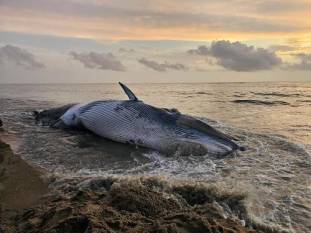


KOCHI, 12 August 2025: The ICAR-Central Marine Fisheries Research Institute (CMFRI) has reported a ten-fold rise in whale strandings along the southwest coast of India over the last decade, raising concerns over the health of marine ecosystems in one of the country’s richest biodiversity zones.
An analysis of data from 2004 to 2023 shows strandings increased from 0.3 per cent per year between 2003 and 2013 to 3 per cent annually in the 2014–2023 period. The surge has been linked to climate-induced changes in ocean ecosystems, anthropogenic pressures such as vessel traffic and fishing activity, and environmental factors including shallow coastal shelves.
Kerala, Karnataka, and Goa accounted for the majority of reported cases, with Bryde’s whale identified as the most commonly stranded species. Blue whales were also occasionally recorded. CMFRI scientists noted the genetic complexity of Bryde’s whales in Indian waters, confirming the presence of two distinct forms.
In 2023 alone, nine strandings were reported — the highest in recent years — mostly between August and November. The study found a positive correlation between chlorophyll-a concentrations, which rise during the southwest monsoon due to nutrient upwelling, and strandings, suggesting whales are drawn closer to coastal feeding grounds during this period. Rising sea surface temperatures and strong converging currents were also cited as contributing factors, with the latter often washing weak or dead animals ashore.
Lead author Dr. R. Ratheesh Kumar, principal investigator of the national project on marine mammal stock assessments, stressed the importance of predictive models using satellite data on chlorophyll, wind patterns, and sea surface temperatures to forecast stranding events. He called for region-specific conservation measures, real-time alert systems, fisher and official training programmes, and the strengthening of citizen science platforms.
The findings, published in Regional Studies in Marine Science, underscore the urgency of establishing robust marine mammal conservation infrastructure along the southwest coast.