




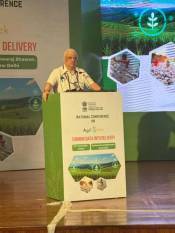


NEW DELHI, 18 June 2025: In a significant step towards revolutionizing Indian agriculture through technology, the Ministry of Agriculture & Farmers’ Welfare (MoA&FW) hosted the National Conference on Agri Stack: Turning Data into Delivery at Sushma Swaraj Bhawan, New Delhi. The event brought together senior officials from the Centre and States, agritech experts, and stakeholders to assess the progress of the Agri Stack initiative and define its next phase under the Digital Agriculture Mission (DAM).
The conference opened with a keynote address by Shri Devesh Chaturvedi, Secretary (Agriculture), who reaffirmed the government’s commitment to building transparent, farmer-centric governance using digital infrastructure. He urged States to synchronize their Farmer Registries with updated Records of Rights (RoR) and use digital tools to enhance scheme delivery and personalized services.
Digital Foundations and New Services
Highlighting the role of land records and Aadhaar linkage, the Secretary of the Department of Land Resources emphasized the critical need for accurate farmer identification, especially in the face of declining rural land values and incomes.
Shri Pramod Kumar Meherda, Additional Secretary (Digital), MoA&FW, detailed the structure of Agri Stack—its integration with flagship schemes like PM-KISAN, PMFBY, and KCC—and announced new digital tools like Digitally Verifiable Certificates (DVCs) and Farmer Authorization Systems. These technologies will empower farmers to securely share verified land and crop data.
A key achievement of the event was the signing of MoUs with Maharashtra, Kerala, Bihar, and Odisha, along with the PSB Alliance, under the National Farmers’ Welfare Program Implementation Society. This partnership aims to deliver credit access seamlessly via Farmer Registry authentication—minimizing paperwork and boosting financial inclusion.
Funding Push and Innovation Showcase
The conference also marked the joint launch of Special Central Assistance (SCA) Guidelines with a ₹6,000 crore allocation: ₹4,000 crore for developing Farmer Registries and ₹2,000 crore for Digital Crop Surveys. States were encouraged to act swiftly to access these funds on a first-come-first-served basis.
Technical sessions addressed current bottlenecks—outdated tribal land records, data quality issues in crop surveys, and standard compliance gaps—while spotlighting solutions like remote sensing, AI/ML integration, and automated data validation.
States like Maharashtra, Uttar Pradesh, and Karnataka shared use cases demonstrating Agri Stack’s practical impact. Maharashtra requested Central support for building a Data Provisioning Engine (DPE) and launching Mahavistaar AI, a sandbox for AI-driven advisories. Karnataka’s multi-layered model integrating FRUITS with banking and disaster relief drew special attention.
Empowering Farmers and Grievance Redressal
One of the event’s standout announcements was the Digitally Verifiable Credential (DVC)—also called Kisan Pehchan Patra—allowing farmers to generate authenticated digital IDs linked to land parcels. Integrated with DigiLocker, these credentials are automatically updated with land mutations.
A new Unified Grievance Redressal Portal was also unveiled, featuring OTP login, multilingual capabilities, and even audio upload features for farmers in dispute resolution. Authorized representatives will be able to act on behalf of farmers through this portal.
AI Tools and Gemini Chatbot Launch
The Ministry introduced a Google Gemini-based AI chatbot, capable of interacting in multiple Indian languages using Agri Stack data. Additional AI tools under development will support crop identification, facial authentication for surveyors, and software optimization for backend systems.
The conference concluded with an interactive open forum moderated by the Additional Secretary (Digital), where States provided feedback and exchanged ideas for improving digital delivery systems. Shri Anindya Banerjee, Deputy Advisor, offered the vote of thanks, celebrating the collaborative momentum behind India’s push toward a data-driven, inclusive agricultural transformation.
By Jagdish Kumar