





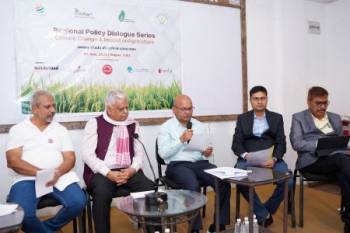


NAGPUR, 30 June 2025: As India grapples with extreme weather and declining soil health, a regional dialogue in Nagpur has called for stronger collaboration between government agencies, private sector players, and farming communities to drive climate-resilient agriculture.
Held under the banner of the Regional Policy Dialogue on Climate Change and Agriculture, and organised by Sustainability Matters and IndiAgri, the event brought together a cross-section of experts, farmers, and policymakers to dismantle policy silos and build a convergent approach for sustainable, climate-ready farming.
“Climate change is no longer a debate, it is a reality that must be responded to through adaptation, not just mitigation,” said Dr. CD Mayee, Former Agricultural Commissioner of India and Chairman, AFC India Ltd. Highlighting the promise of rapid biotechnological advances, he cited ICAR’s swift development of two drought-resistant rice varieties within just two years as evidence that India can adapt with speed if given policy backing.
Dr. V N Waghmare, Director of the Central Institute for Cotton Research (CICR), drew attention to shifting rainfall patterns in Vidarbha, where annual precipitation has crossed 1,000 mm from a previous 700–800 mm average. He stressed the importance of breeding stress-tolerant crops while maintaining soil carbon and exploring artificial intelligence-based tools to guide breeding and pest management.
Dr. Sharad Nimbalkar, former Vice Chancellor of PDKV, highlighted the urgency of prioritizing soil health in climate strategies, warning that topsoil organic carbon losses directly threaten productivity and farmer livelihoods. He proposed watershed-based regeneration models led by universities and research institutions.
Adding a policy delivery perspective, Shri Ravindra Manohare, District Superintendent Agriculture Officer, Government of Maharashtra, spotlighted POCRA — a ₹6,000-crore World Bank-supported initiative across 7,000 villages — and the critical role of farmer participation. “Bottom-up planning and location-specific interventions are essential for climate resilience,” he said, citing the SATHI app as a traceable seed system innovation.
Dr. Navneet Anand, Executive Director of Sustainability Matters and Editor-in-Chief of IndiAgri, summed up the event’s theme: “The future of Indian agriculture cannot be secured in isolation. Through platforms like this Regional Dialogue, we aim to catalyse conversations that lead to collaboration, and collaboration that leads to action.”
Participants included prominent voices from seed companies, fertilizer firms, progressive farmer organizations, and government agencies, all underscoring that climate resilience is a shared mission demanding public-private-farmer synergy.
The Nagpur policy dialogue, part of a nationwide series on sustainable agriculture, concluded by reaffirming that only collaborative and innovation-driven solutions can equip Indian farmers to withstand a future marked by climate volatility.