





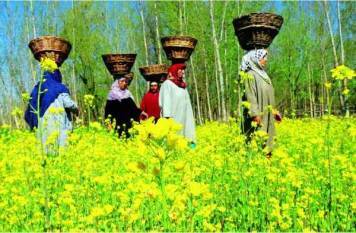


SRINAGAR, 29 May 2025: The contribution of the agriculture sector to Jammu and Kashmir’s GDP has dropped to just 20%, down from 28% fifteen years ago, signaling a deep shift in the region’s economic structure.
According to the Economic Survey 2023–24, the primary sector—which includes agriculture, horticulture, fishing, aquaculture, forestry, and mining—has steadily lost ground due to unplanned development and the conversion of fertile farmland for non-agricultural use.
Officials warn that the ongoing decline has not only weakened local food production but has also made J&K increasingly dependent on external food supplies. This dependency contributes to capital outflows and higher inflation, with the region frequently recording inflation rates above the national average. The shift in economic contribution comes even as the services sector now dominates with a 61.7% share of the Gross Value Added (GVA), powered by trade, tourism, hospitality, IT, education, and healthcare.
The secondary sector, which includes manufacturing, construction, and utilities, holds an 18.3% share. The government continues to invest in infrastructure and connectivity to boost industrial growth. However, experts argue that agriculture still holds untapped potential to combat unemployment and stabilize the economy. “Kashmir’s natural resources and climate favor agriculture, but we are not leveraging them,” said Javid Ahmad Tenga, President of the Kashmir Chamber of Commerce and Industry.
Tenga called for stricter enforcement of laws protecting farmland and highlighted the urgent need for crop diversification and water-efficient farming practices. Proposals include replacing water-intensive crops like rice with high-value, low-water crops such as red cabbage, broccoli, and parsley. This approach not only addresses climate challenges—such as the 80?cline in rainfall and snowfall—but also boosts income potential. High-value vegetable cultivation could earn farmers ₹7–8 lakh per hectare annually, compared to ₹1.6 lakh from rice.
Maize cultivation also shows promise for transformation. Switching from traditional maize to baby corn or sweet corn varieties, along with value-added processing, could significantly increase farmer income. Additionally, horticulture through high-density plantations of apples, walnuts, and cherries is seen as another key growth driver.
Despite comprehensive recommendations, poor enforcement of land-use policies continues to hinder progress. Experts stress that unless on-ground implementation improves, the agricultural sector in J&K will continue to decline, worsening rural distress and economic imbalance.
Image credit: civilsocietyonline.com