





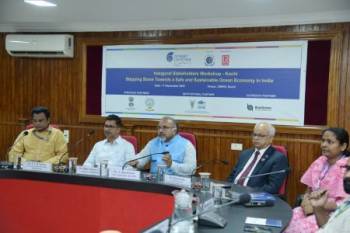


KOCHI, 11 September 2025: Traditional knowledge of coastal communities — ranging from reading weather patterns to boat building — holds the potential to significantly enhance safety and sustainability in India’s marine fisheries, according to experts.
Speaking at a stakeholder workshop organised by the ICAR-Central Marine Fisheries Research Institute (CMFRI) here on Thursday, specialists in fisheries, shipping, and ports underlined the value of blending indigenous wisdom with modern technology. Satellite modelling and remote sensing, when paired with local knowledge, could deliver localised weather warnings and accurate monsoon forecasts, they said.
“In generations past, fishermen relied on their intimate understanding of the sea — reading wind direction, currents, and sea swells — to predict weather and locate fish,” observed Dr. A. Biju Kumar, Vice Chancellor, Kerala University of Fisheries and Ocean Studies (KUFOS), inaugurating the event.
The workshop also highlighted the famed boat-building tradition of Kerala’s “Khalasis,” who construct the legendary “uru” vessels without blueprints or modern machinery. Dr. Biju Kumar suggested that documenting such practices could contribute to a hybrid model of maritime engineering, combining artisanal expertise with scientific precision.
Participants flagged illegal, unreported, and unregulated (IUU) fishing as a major threat to India’s marine resources. Leveraging technology for monitoring and ensuring compliance was recommended to protect fish stocks. The discussions further drew attention to climate change impacts, including weakened monsoon dynamics, rising temperatures, and disrupted upwelling.
Panelists emphasised the need for hybrid coastal protection strategies, such as bio-fencing and bio-shielding with indigenous materials, instead of hard structures that damage fragile ecosystems. Addressing plastic pollution, the meet proposed forming a ‘Blue Brigade’ of coastal women to spearhead awareness and clean-up efforts.
The workshop, organised by Ocean Centres India in collaboration with the UN Global Compact Network India and CMFRI, called for a participatory approach to fisheries policy. Stakeholders from institutions including the National Institute of Fisheries Post Harvest Technology and Training (NIFPHATT) contributed to the discussions.