





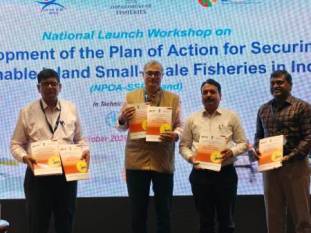


BHOPAL, 25 October 2026: Women account for nearly 44% of India’s 23.12 million inland fisher population, while pollution, habitat degradation and insecure access to fishing resources threaten the sustainability of the sector, according to a country profile prepared by the Bay of Bengal Programme Inter-Governmental Organisation (BOBP-IGO) in association with the Food and Agriculture Organization (FAO) of the United Nations.
The report highlights the need to improve the recognition of women’s contributions to inland fisheries, strengthen environmental protection and address livelihood challenges affecting small-scale fishing communities.
According to the country profile, women constitute approximately 10.10 million of India’s 23.12 million inland fishers. However, their contributions to post-harvest activities and unpaid family work remain inadequately documented in available fisheries statistics.
The profile was presented during a national workshop in Bhopal, Madhya Pradesh, held as part of efforts to develop a National Plan of Action (NPOA) for small-scale inland fisheries.
Pollution and Habitat Degradation Threaten Inland Fisheries
The report identifies pollution, degradation of aquatic habitats and disrupted river connectivity as major concerns for India’s inland fisheries.
Competing demands for freshwater, particularly for irrigation and other uses, are placing additional pressure on water resources and the ecosystems that support fish populations. Floods, droughts and reservoir drawdown also pose challenges for fisheries-dependent communities.
These pressures highlight the need to integrate fisheries management into broader water-resource planning and strengthen measures to protect aquatic habitats.
Dr P. Krishnan, Director of BOBP-IGO, said these concerns had become increasingly significant amid growing attention to climate resilience and the sustainable management of freshwater resources.
Maintaining aquatic habitats and accounting for fisheries requirements in water-resource planning are important to sustaining fish populations and protecting the livelihoods of communities dependent on inland fisheries, he said.
Insecure Fishing Rights and Coordination Gaps
The country profile also highlights insecure access to fishing grounds and challenges associated with leasing arrangements.
Overlapping responsibilities among fisheries, irrigation, forest, revenue and local authorities can complicate the management of inland water bodies and the implementation of fisheries-related interventions.
Addressing these issues will require improved coordination among government departments, clearer arrangements for fishing access and stronger participation by local fishing communities in resource management.
The findings are particularly relevant to the proposed National Plan of Action, which aims to establish a coordinated framework for sustainable fisheries management and livelihood security.
Data Gaps Conceal Women’s Contributions
The report flags shortcomings in data collection, particularly concerning subsistence fishing and informal fish marketing channels, which remain under-represented in available statistics.
Dr Krishnan emphasised that better data on fishers, catches and individual water-body ecosystems could help authorities develop targeted interventions and assess the contribution of small-scale fisheries to livelihoods and food security.
Improved documentation of women’s roles is also important to ensure that fisheries policies and development programmes reflect their contributions and needs.
Women participate in multiple parts of the fisheries value chain, including post-harvest activities and family-based work. Inadequate recording of these activities can limit the visibility of their economic contribution and leave gaps in policy planning.
National Action Plan to Support Sustainable Fisheries
India is developing a National Plan of Action for small-scale inland fisheries to strengthen sustainable resource management, stakeholder engagement and livelihood security.
The two-day national workshop is being organised by the Department of Fisheries, Government of India, in collaboration with BOBP-IGO and hosted by the Government of Madhya Pradesh. The process includes technical oversight from FAO and scientific support from fisheries institutes under the Indian Council of Agricultural Research (ICAR).
The proposed framework is aligned with the FAO’s Voluntary Guidelines for Securing Sustainable Small-Scale Fisheries, which emphasise responsible fisheries management and the protection of the livelihoods and rights of small-scale fishing communities.
The report’s findings underline the importance of incorporating gender-sensitive planning, better fisheries data, secure fishing access and ecosystem protection into the national action plan.
Strengthening these areas could help India improve the resilience of inland fisheries while supporting the communities that depend on freshwater resources for income, employment and food security.