





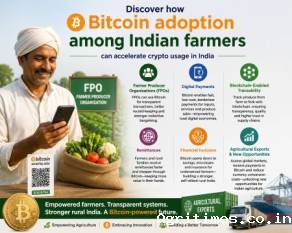


MUMBAI, 9 July 2026: India has quietly emerged as one of the world's largest cryptocurrency markets. According to global blockchain analytics, India consistently ranks among the top countries for crypto adoption, driven largely by retail investors, developers, and freelancers. Yet one of the country's largest economic communities—its nearly 150 million farmers—remains largely disconnected from the digital asset economy.
If Bitcoin adoption reaches even a fraction of India's farming population, it could fundamentally reshape not only the country's crypto landscape but also rural finance, agricultural trade, and global food exports.
The opportunity extends far beyond simply buying Bitcoin as an investment. It lies in using Bitcoin and blockchain technology to solve long-standing problems around payments, market access, transparency, and financial inclusion.
Why agriculture presents a unique opportunity
Agriculture contributes around 16–18% of India's GDP while supporting the livelihoods of more than half of the country's population. Millions of farmers continue to face delayed payments, high transaction costs, fragmented supply chains, limited access to institutional finance, and dependence on intermediaries.
At the same time, smartphone penetration, digital banking, Aadhaar authentication, UPI payments, and internet connectivity have expanded rapidly across rural India.
This digital infrastructure provides a strong foundation for introducing blockchain-based financial services, with Bitcoin acting as one of the gateways into the broader Web3 ecosystem.
Beyond speculation: Bitcoin as financial infrastructure
Many people still associate Bitcoin solely with price speculation.
However, globally, Bitcoin is increasingly viewed as financial infrastructure, particularly in regions where banking access is limited.
Indian farmers could benefit in several practical ways:
- Cross-border payments for agricultural exports
- Faster settlement of international transactions
- Protection against delayed payments
- Low-cost remittances from family members working overseas
- Digital savings independent of traditional banking hours
While regulatory clarity continues to evolve in India, these use cases demonstrate that Bitcoin's value extends well beyond investment.
Farmer Producer Organisations can drive mass adoption
India already has more than 10,000 Farmer Producer Organisations (FPOs), collectively representing millions of farmers.
Rather than expecting individual farmers to understand cryptocurrencies independently, FPOs can become trusted digital intermediaries.
An FPO could:
- Educate members about digital assets.
- Accept international payments where regulations permit.
- Maintain transparent blockchain records for transactions.
- Build digital wallets for collective operations.
- Reduce payment settlement time for export buyers.
- Improve trust among overseas purchasers.
Instead of thousands of individual crypto users, India could see thousands of crypto-enabled agricultural cooperatives.
Bitcoin can improve agricultural exports
Indian agricultural exports continue to expand into Europe, the Middle East, Africa, and Southeast Asia.
Exporters often wait several days for international settlements while paying substantial banking fees.
Bitcoin-based payment rails could eventually complement existing banking systems by enabling faster settlements for overseas buyers, subject to applicable regulations.
This becomes particularly relevant for exports of:
- Organic produce
- Coffee
- Tea
- Spices
- Fruits
- Vegetables
- Dairy products
- Specialty grains
Blockchain records can also enhance traceability by documenting every stage—from cultivation and harvesting to logistics and export—creating greater confidence among international buyers.
Blockchain creates trusted agricultural records
Perhaps an even bigger opportunity lies beyond payments.
Blockchain enables immutable records covering:
- Land ownership
- Crop history
- Organic certifications
- Carbon credits
- Water usage
- Input application
- Supply-chain movement
Companies such as Syngenta Foundation India have already demonstrated how blockchain can securely store agricultural data that banks, insurers, traders, and government agencies can reuse.
This trusted data can make it easier for farmers to access credit, insurance, and premium markets.
Carbon credits open new revenue streams
Indian agriculture is increasingly participating in regenerative farming, methane reduction, sustainable rice cultivation, and soil carbon programmes.
Blockchain can ensure carbon credits are transparent, verifiable, and easily traded.
Farmers adopting climate-smart agriculture could receive additional income beyond crop sales.
Several startups are already exploring blockchain-based carbon markets that reward sustainable farming practices.
Bitcoin itself may not represent the carbon credits, but blockchain ecosystems can securely manage ownership and payments associated with these environmental assets.
AI, IoT and Bitcoin form a powerful ecosystem
Modern agriculture is rapidly becoming data-driven.
AI-powered cattle monitoring, smart irrigation systems, drone mapping, satellite imagery, precision fertiliser application, and IoT sensors generate enormous amounts of farm data.
Blockchain can verify this information, while Bitcoin and digital payment systems can facilitate financial transactions based on trusted data.
For example:
- Smart cow collars monitor livestock health.
- Satellite imagery verifies crop acreage.
- AI predicts disease outbreaks.
- Blockchain stores verified records.
- Bitcoin-based payment rails facilitate international trade.
Together, these technologies create a digital agricultural ecosystem that is transparent, efficient, and globally connected.
Education remains the biggest challenge
Technology alone will not drive adoption.
Farmers need practical education rather than complex explanations about cryptography or decentralisation.
Training programmes led by FPOs, agricultural universities, Krishi Vigyan Kendras (KVKs), AgriTech startups, fintech companies, and blockchain organisations can demonstrate real-world benefits.
Topics should include:
- Wallet security
- Scam prevention
- Digital payments
- Blockchain traceability
- Cross-border trade
- Regulatory compliance
- Responsible digital asset usage
Financial literacy must remain the foundation of any adoption strategy.
Regulatory clarity will determine the pace
India has not recognised Bitcoin as legal tender, and cryptocurrency taxation remains in place. However, blockchain innovation continues to receive support across multiple sectors, including agriculture, supply chains, and financial technology.
A balanced regulatory framework that protects consumers while encouraging responsible innovation could unlock significant opportunities for rural India.
Rather than replacing traditional banking, Bitcoin can evolve as a complementary financial tool for specific use cases such as exports, remittances, and digital asset diversification.
The road ahead
India has the world's largest dairy sector, one of the biggest agricultural economies, thousands of FPOs, rapidly expanding digital infrastructure, and a vibrant blockchain developer community.
If farmer organisations begin integrating Bitcoin-enabled payment solutions, blockchain traceability, carbon-credit marketplaces, and AI-powered agricultural data, they could become one of the strongest catalysts for mainstream crypto adoption in the country.
The next phase of India's crypto journey may not begin in metropolitan trading rooms or technology parks—it could emerge from village cooperatives, digital farmer collectives, and export-oriented FPOs embracing a new generation of financial innovation.
Bitcoin adoption among Indian farmers is therefore not merely about cryptocurrency. It is about creating a more transparent, efficient, globally connected, and financially inclusive agricultural economy where farmers gain greater control over payments, market access, and the value they create.