





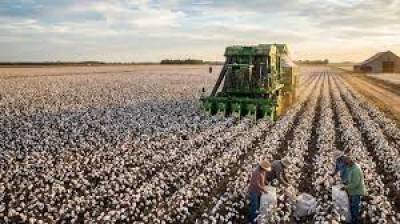


NEW DELHI, 15 May 2026: The Union Cabinet chaired by Prime Minister Narendra Modi has approved the ambitious Mission for Cotton Productivity with an outlay of INR 5,659.22 crore for the period 2026–27 to 2030–31, aimed at transforming India’s cotton sector through technology, sustainability, quality enhancement, and farmer-centric reforms.
The mission seeks to address declining cotton productivity, pest-related crop losses, quality concerns, and supply chain inefficiencies while positioning India as a global leader in sustainable cotton and textile exports.
Aligned with the Government’s 5F vision — Farm to Fibre to Factory to Fashion to Foreign, the programme is expected to improve farmer incomes, strengthen domestic textile manufacturing, and enhance India’s competitiveness in international markets.
Focus on High-Yield and Climate-Resilient Cotton
A major component of the mission is the development of high-yielding, climate-resilient and pest-resistant cotton seeds to improve productivity and reduce crop vulnerability.
The programme will support:
- Development of disease- and pest-resistant cotton varieties
- Promotion of climate-smart farming practices
- Large-scale adoption of modern crop technologies
- Farmer training and extension activities
The government will upscale advanced cultivation systems including:
- High Density Planting System (HDPS)
- Closer Spacing (CS)
- Integrated Cotton Management
- Extra Long Staple (ELS) Cotton cultivation
These interventions will be implemented through State Agriculture Departments, Krishi Vigyan Kendras (KVKs), State Agricultural Universities (SAUs), and ICAR institutes.
Mission Targets 498 Lakh Bales by 2031
The Mission aims to increase India’s cotton production to 498 lakh bales by 2031 while significantly improving lint productivity from 440 kg per hectare to 755 kg per hectare.
Around 32 lakh cotton farmers are expected to benefit from the programme through improved technology adoption, better market access, enhanced productivity, and higher-quality output.
Strengthening Cotton Quality and Traceability
The government will focus heavily on cotton quality improvement through modernization of ginning and processing factories and strengthening cotton testing infrastructure.
Key initiatives include:
- Modern accredited cotton testing laboratories
- Standardised quality assessment systems
- Best processing practices in ginning factories
- Reduction of cotton contamination and trash content below 2%
The Mission also plans to scale up the Kasturi Cotton Bharat initiative to establish India as a trusted supplier of premium sustainable cotton globally.
Traceability and certification systems will help improve transparency, branding, and export competitiveness in global textile markets.
Digital Integration and Farmer Empowerment
To improve price discovery and market access, the Mission will promote digital integration of agricultural mandis and e-platforms.
This will enable:
- Transparent cotton trading
- Better realization for farmers
- Improved market connectivity
- Direct access to buyers
The programme also encourages cotton waste recycling and circular economy practices to improve sustainability and resource efficiency across the textile value chain.
Promoting Sustainable Natural Fibres
In addition to cotton, the Mission aims to diversify India’s fibre ecosystem by promoting natural fibres such as:
- Flax
- Ramie
- Sisal
- Milkweed
- Bamboo
- Banana fibre
The move aligns with rising global demand for sustainable and eco-friendly textile materials.
Multi-Institutional Implementation Framework
The Mission will be jointly implemented by the Ministry of Agriculture & Farmers Welfare and the Ministry of Textiles.
The implementation network includes:
- 10 ICAR institutes
- 1 CSIR institute
- 10 AICRP cotton research centres
- State Agricultural Universities
- Agriculture Departments in 14 cotton-growing states
Initially, the programme will focus on 140 cotton-growing districts and around 2,000 ginning and processing factories across India.
The Cabinet’s approval marks one of the country’s most significant cotton-sector interventions aimed at achieving self-reliance, improving sustainability, and strengthening India’s position in global textile and apparel supply chains.
Image credit: knnindia.co.in