





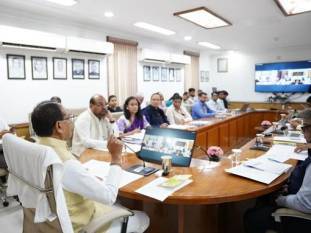


Union Minister for Agriculture and Farmers Welfare and Rural Development Shivraj Singh Chouhan chaired a high-level virtual review meeting with state agriculture ministers, district collectors, scientists from the Indian Council of Agricultural Research (ICAR), experts from ICAR-CRIDA, and officials from the India Meteorological Department (IMD) to assess preparedness measures across the country.
Addressing the media after the meeting, Chouhan said the southwest monsoon has been significantly delayed, with rainfall levels currently estimated to be around 43 percent below normal. Forecasts indicate that rainfall could remain weak through early July, posing risks to Kharif crops, particularly in rainfed regions that depend heavily on monsoon precipitation.
“We are preparing in advance and not waiting for the situation to worsen,” Chouhan said, emphasizing that both the Centre and state governments are working together to minimize potential disruptions to agricultural production.
315 Districts Identified as Vulnerable
Based on scientific assessments conducted jointly by the Ministry of Agriculture and ICAR, around 315 districts have been identified as vulnerable to low rainfall and inadequate irrigation.
Among these, 111 districts have been categorized as high-priority areas due to irrigation coverage below 25 percent. Another 76 districts fall under the medium-priority category, while 128 districts have been classified as lower risk because of relatively better irrigation infrastructure.
Most of the vulnerable districts are spread across 12 states, including Madhya Pradesh, Maharashtra, Gujarat, Uttar Pradesh, Rajasthan, Karnataka, Bihar, Jharkhand, Telangana, Andhra Pradesh, and Odisha.
District-Level Contingency Plans Ready
To mitigate potential losses, ICAR and ICAR-CRIDA have prepared District Agriculture Contingency Plans (DACPs) for all districts. These plans include district-specific recommendations on alternative crops, water management strategies, crop diversification practices, and supplementary income opportunities for farmers.
The minister instructed state governments and district administrations to ensure that these plans are implemented on the ground rather than remaining as administrative documents.
Water Conservation Gets Top Priority
Recognizing water scarcity as a major risk under El Niño conditions, the government has prioritized water conservation measures nationwide.
States have been directed to repair and strengthen ponds, reservoirs, check dams, farm ponds, and other water-harvesting structures. Water conservation projects under MGNREGA and upcoming rural development programmes are also being accelerated to improve storage capacity while generating rural employment.
Districts facing potential water shortages have been advised to prioritize drinking water needs and explore water transfer options where necessary.
Shift Towards Climate-Smart Cropping
The government has advised states to encourage farmers to adopt short-duration crop varieties and crops that require less water while offering stable yields.
Special emphasis is being placed on pulses, millets (Shri Anna), and oilseeds, which generally perform better under limited moisture conditions. Farmers are also being encouraged to diversify cropping systems and adopt intercropping practices to reduce risks associated with monsoon uncertainty.
Officials noted that alternative cropping strategies will be activated quickly if significant delays occur in rainfall during the sowing period.
Seeds and Fertilisers Available in Adequate Quantities
The Agriculture Ministry has assured farmers that adequate stocks of seeds and fertilizers are available for the Kharif season.
Additional seed reserves have been earmarked for vulnerable districts, including contingency stocks for potential resowing requirements. Fertilizer availability, including urea, DAP, MOP, NPK, and SSP, has been reported as satisfactory.
The government has also advised farmers against premature sowing, recommending planting only after receiving cumulative rainfall of 75–100 mm and adequate soil moisture levels.
Scientific Advisory Network Strengthened
The country's network of 731 Krishi Vigyan Kendras (KVKs) will play a central role in disseminating scientific advisories and weather-related guidance.
Information on crop planning, rainfall forecasts, and contingency measures will be communicated through SMS alerts, WhatsApp messages, radio, television broadcasts, call centres, and social media platforms to ensure timely outreach to farmers.
Livestock and Fodder Preparedness
The Centre has also prepared contingency plans to address potential fodder shortages arising from a weak monsoon.
Officials are developing supply chains to transport fodder from surplus regions to deficit areas, while monitoring systems are being strengthened to prevent hoarding and black marketing.
Financial Safety Nets for Farmers
The government is relying on three major support mechanisms to provide financial protection to farmers:
- Pradhan Mantri Fasal Bima Yojana (PMFBY) for crop insurance coverage.
- Kisan Credit Card (KCC) to facilitate access to affordable credit.
- PM-KISAN income support payments to help farmers purchase seeds, fertilizers, and other inputs.
States have been directed to expand PMFBY coverage and accelerate the issuance of KCCs in vulnerable districts.
Multi-Tier Monitoring Framework Established
To ensure effective implementation, the Centre has established a multi-level coordination system involving central ministries, state governments, district administrations, water resource departments, agriculture departments, animal husbandry agencies, and scientific institutions.
An El Niño Monitoring Cell and a Crop Weather Watch Group have been set up in New Delhi to track monsoon progress, crop sowing trends, input supplies, and market developments in real time.
Weekly reviews are being conducted at the secretary level, while the agriculture minister has committed to personally monitoring the situation every Tuesday.
Food Security Remains Secure
Despite concerns over monsoon performance, the government remains confident about food security. Officials noted that buffer stocks of rice and wheat remain comfortable and that a foodgrain production target of approximately 176 million tonnes has been set for Kharif 2026.
Concluding his remarks, Chouhan urged farmers not to panic and emphasized that preparedness, scientific planning, water conservation, crop diversification, and coordinated action can significantly reduce the impact of El Niño on Indian agriculture.
“Together, we can protect our agriculture, livestock, and rural economy while safeguarding farmers’ livelihoods,” he said.