





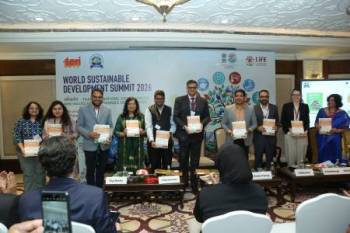


NEW DELHI, 10 March 2026: The Energy and Resources Institute (TERI) showcased a series of new research outputs and practical tools aimed at accelerating the deployment of agrivoltaics (AgriPV) in India during the silver jubilee edition of the World Sustainable Development Summit 2026.
Agrivoltaics—the integration of solar photovoltaic systems with agricultural land—is emerging as a promising approach to expand renewable energy generation while preserving farmland and supporting rural livelihoods.
New Research and Tools for AgriPV Deployment
During a thematic session titled “Accelerating AgriPV in India: From Pilots to Policy-Led Scale-Up,” TERI launched two research reports, a project development framework and a digital decision-support tool designed to support responsible scaling of agrivoltaic projects.
The releases included:
-
Responsible Agri-PV Baseline Assessment Report – Khare Energy, Madhya Pradesh
-
Responsible Agri-PV Baseline Assessment Report – Renkube, Telangana
-
Agri-PV DPR (Detailed Project Report) Framework
AgriPV Business Model Selection Tool
The baseline assessment reports present field-level insights from agrivoltaic installations in Madhya Pradesh and Telangana, focusing on site conditions, crop compatibility and implementation practices across different agro-climatic regions.
The Agri-PV DPR Framework provides structured guidance for preparing project reports by outlining key technical, financial and environmental parameters required to develop bankable agrivoltaic projects.
Meanwhile, the AgriPV Business Model Selection Tool helps developers, policymakers and financial institutions evaluate project configurations and identify the most suitable implementation models based on local conditions and financial viability.
Policy Support for Emerging Renewable Applications
Delivering the keynote address, Santosh Kumar Sarangi, Secretary at the Ministry of New and Renewable Energy, highlighted the role of strong policy frameworks in driving India’s renewable energy expansion.
He noted that transparent bidding systems, renewable purchase obligation (RPO)-linked demand visibility and confidence-building measures for DISCOMs are essential to scale emerging renewable applications such as agrivoltaics.
Importance of Crop Research in AgriPV Systems
In a special address, A. K. Singh emphasized that crop selection plays a crucial role in agrivoltaic system design.
He pointed out that some crops may perform well under partial shade from solar panels, while others could face disease risks or yield penalties, underscoring the need for long-term agronomic research.
Key Insights from the Session
Experts at the session highlighted several factors critical for the successful scale-up of agrivoltaics in India:
- Optimising land use: Integrating solar energy with farming helps address the food–energy–land nexus.
- Farmer-centric business models: Ensuring fair benefit-sharing and farmer participation is essential.
- Evidence-based crop research: Long-term studies are needed to guide system design.
- Supportive policy frameworks: Transparent market mechanisms and predictable policies will drive investments.
- Rural development benefits: Agrivoltaics can boost farmer incomes, strengthen climate resilience and expand distributed energy access.
The announcements at WSDS 2026 reinforce TERI’s efforts to build an evidence-based ecosystem for agrivoltaics while promoting sustainable agriculture, renewable energy adoption and rural development in India.
Image credit: Tata Power