





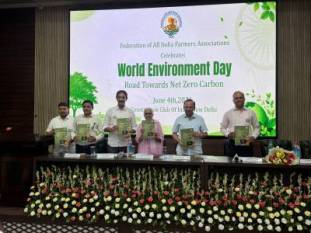


NEW DELHI, 4 June 2026: The Federation of All India Farmer Associations (FAIFA) on Thursday released a landmark report urging India to accelerate the transition towards climate-resilient farming systems as rising climate variability, extreme weather events and potential El Niño conditions pose growing risks to agriculture.
The report, titled "Inspired by Nature: El Niño-Ready Farming for Climate Resilience and Our Future", was unveiled on World Environment Day by Shri Magunta Sreenivasulu Reddy, Member of Parliament from Ongole, Andhra Pradesh, during a seminar focused on sustainable and climate-resilient agriculture.
The report highlights increasing threats from extreme heat, erratic rainfall, soil degradation, groundwater stress and resource-intensive farming practices, while outlining a roadmap to strengthen agricultural resilience and safeguard food security.
Speaking at the event, Shri Reddy said the Government of India has taken significant steps to promote sustainable agriculture through initiatives such as digital agriculture, natural farming, clean energy adoption and farmer empowerment programs.
A key focus of the report is the impact of El Niño events, which have historically been linked to weaker monsoons, moisture deficits and heightened risks during the Kharif season. FAIFA emphasized that agricultural planning must increasingly prioritize preparedness, adaptation and risk management.
The report advocates a dual transition combining ecological sustainability and technological innovation. It recommends improving soil health, promoting crop diversification, enhancing water-use efficiency, reducing excessive dependence on chemical inputs and encouraging nature-based farming systems.
FAIFA noted that several government initiatives have already laid the foundation for climate-resilient agriculture, including the Digital Agriculture Mission, AgriStack, Bharat-VISTAAR, National Mission on Natural Farming, PM-KUSUM, Pradhan Mantri Fasal Bima Yojana (PMFBY), and the National Innovations in Climate Resilient Agriculture (NICRA) programme.
Among its key recommendations, the report calls for rapid expansion of AgriStack and Bharat-VISTAAR platforms, wider adoption of natural farming through women-led networks such as Krishi Sakhis, technology-enabled crop insurance, protective irrigation systems and region-specific climate adaptation strategies.
The report also raises concerns over worsening climate risks. According to its findings, India experienced extreme weather events on 331 out of 334 days between January and November 2025, impacting more than 17 million hectares of cropped area. It further notes that 97% of tested soil samples were deficient in nitrogen, while 85% lacked adequate organic carbon.
Addressing the seminar, P.S. Murali Babu, President of FAIFA, said climate change is already affecting farming communities across India and resilience must become the guiding principle for future agricultural development.
"By combining traditional ecological wisdom, scientific innovation, digital technologies and farmer-centric policies, India can build an agricultural system that is productive, sustainable and better prepared for future climate shocks," he said.
Experts participating in the event highlighted the role of emerging technologies such as artificial intelligence, satellite monitoring, remote sensing, precision irrigation and weather-based advisory systems in improving farm-level decision-making and reducing climate-related risks.
The report also underlined the importance of traditional agricultural practices, including crop diversification, mixed farming, intercropping and indigenous water management systems, as valuable tools for climate adaptation.
FAIFA concluded that India has a unique opportunity to build one of the world's most resilient agricultural systems by leveraging its scientific institutions, digital infrastructure, policy ecosystem and rich agricultural heritage.
The event also recognised climate-resilient farmers, agricultural innovators and Farmer Producer Organisations (FPOs) that are promoting environmentally sustainable and resource-efficient farming practices across the country.