






NEW DELHI, 16 November 2026: Mobile-based soil testing and artificial intelligence (AI) tools could help Indian farmers make more informed decisions on fertiliser use, crop selection and pest management, as the government looks to expand the role of technology in agriculture.
Addressing the Kisan Tak Bharat Agriculture Conference at Bharat Mandapam on November 12, Prime Minister Narendra Modi said arrangements were being developed for soil testing through mobile phones. The proposed technology would allow farmers to test a soil sample using a mobile-based device and receive information on suitable crops and the type and quantity of fertiliser required.
He also highlighted the development of affordable, sensor-based equipment using AI to provide farmers with more precise information.
Several technologies already being developed and deployed in India offer an indication of how this approach could work.
Pocket-sized devices bring soil testing closer to farms
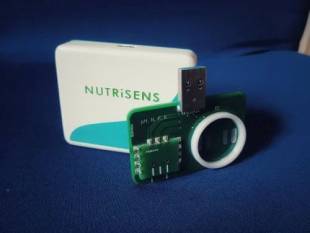
Pune-based NutriSens, developed by scientist Dr Rajul Patkar, uses approximately one gram of soil to test six key parameters in less than five minutes. The results are displayed through a mobile app. According to NITI Aayog's Frontier Tech Hub, the device is being used in eight states, including Assam, Punjab and Rajasthan, reaching an estimated 10,000 to 15,000 farmers.
The technology uses disposable paper strips containing electrodes coated with chemicals that react to specific soil components. A reader measures the resulting electrical signals and converts them into readings.
Research by Patkar and colleagues at IIT Bombay, published in the IEEE Sensors Journal in 2020, described a low-cost paper-based soil pH sensor. However, electrochemical sensors require regular calibration and can be affected by temperature and interfering substances. A 2024 review in Precision Agriculture also noted that such sensors can be more reliable for nitrate and pH measurements than for phosphate.
Another approach uses light rather than chemical reactions. IIT Kanpur's Bhu-Parikshak device uses near-infrared light to analyse around five grams of dry soil and sends results to a mobile phone through Bluetooth in approximately 90 seconds.
The technology identifies patterns in how soil absorbs light and uses computer models trained on laboratory-tested samples to estimate soil properties. Research reviews indicate that near-infrared methods can predict organic carbon and total nitrogen relatively well, but estimating available phosphorus and potassium remains more challenging. Soil moisture and soil type can also affect readings.
AI-based crop disease detection expands
AI is also being applied to identify crop diseases from photographs.
A 2016 study published in Frontiers in Plant Science trained a deep-learning model using 54,306 leaf images covering 14 crops and 26 diseases. The model achieved 99.35 per cent accuracy under controlled conditions, but its performance fell to around 31% when tested on images taken in different environments. The findings highlighted the difficulty of translating laboratory performance into real farm conditions.
India's National Pest Surveillance System (NPSS) allows farmers and extension workers to photograph damaged plants and receive diagnostic advice. The system covers 436 pests across 73 crops. The Plantix app, another AI-based crop diagnostic platform, has recorded more than 30 million downloads, according to ICRISAT.
However, access to digital advice does not always translate into action. A 2025 study of 1,422 farmers across 30 districts of Odisha, published in the Indian Journal of Extension Education, found that only 49% of NPSS advisories were followed. Adoption was particularly low when pest attacks were severe or recommended treatments were expensive and complicated.
Digital advice can influence farming decisions
Research also suggests that mobile-based agricultural advice can improve farm outcomes. A 2019 analysis published in Science, co-authored by Nobel laureate Michael Kremer, found that mobile phone-based advice increased crop yields by 4% and the likelihood of farmers adopting recommended inputs by 22%.
The government is expanding digital advisory services through Bharat-VISTAAR, an AI-powered platform launched in Jaipur on February 17, 2026. It provides agricultural information through a chatbot, mobile app and voice assistant called Bharati, as well as the helpline 155261. The platform draws on weather, market, pest and Soil Health Card information. By August 2026, it had addressed more than 93 lakh queries from over 5.9 lakh farmers.
A separate AI-based local monsoon forecasting pilot reached more than 3.88 crore farmers through SMS in 2025. According to government-reported findings, 31% to 52% of surveyed farmers in Madhya Pradesh and Bihar changed their planting decisions based on the forecasts.
Other digital initiatives include Meghdoot, which provides weather-based crop advisories across nearly 700 districts, and AgriStack, under which more than 10.33 crore Farmer IDs have been created. The electronic National Agriculture Market (e-NAM) connects 1,656 mandis.
Making technology useful to farmers remains the challenge
Agricultural experts say the value of these tools will depend on how effectively scientific measurements are translated into practical farm-level recommendations.
At the conference, Mahesh Girdhar, President of Agriculture Solutions at MAL, highlighted nutrient use efficiency, or the proportion of applied fertiliser nutrients absorbed by crops. He put nitrogen use efficiency at 30% to 45%, phosphorus at 15% to 25% and potash at around 50%.
Soil testing can help farmers make more targeted fertiliser applications. A National Productivity Council study covering 1,700 farmers across 19 states found that farmers who followed Soil Health Card recommendations used 8% to 10% less chemical fertiliser and recorded 5% to 6% higher yields.
However, accurate soil sampling remains essential. A small sample must represent an entire field, requiring farmers to collect soil from multiple locations and mix it properly. Different forms of nutrients, soil conditions and environmental factors can also affect test results.
Dr Stanford Blade of the International Crops Research Institute for the Semi-Arid Tropics (ICRISAT) said at the conference that a farmer-friendly near-infrared nitrogen testing technology was close to being ready.
The next step is to make these technologies affordable, reliable and accessible, while ensuring that farmers can understand and act on the advice they receive. Their success will depend not only on the accuracy of sensors and AI models but also on effective extension services and farmer adoption.
By Jagdish Kumar