





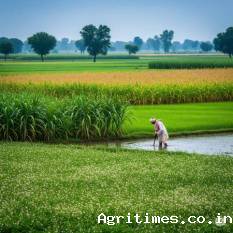


LUCKNOW, 25 June 2025: As the southwest monsoon begins to drench the fields of Uttar Pradesh, farmers across the state gear up for the most critical sowing season of the year—the Kharif season. With over 70% of UP’s population dependent on agriculture, choosing the right crops during the rainy season can mean the difference between a thriving harvest and economic strain.
Here are the top five crops recommended for Kharif 2025 in Uttar Pradesh, balancing yield potential, market demand, and climate adaptability.
1. Paddy (Rice): The Backbone of Kharif Season
Paddy is the most widely grown Kharif crop in Uttar Pradesh, particularly in the eastern and central regions. With consistent government support, procurement policies, and well-established irrigation networks, paddy remains a reliable choice for most farmers.
Sowing Period: June to July
Ideal Rainfall: 1000–1200 mm
Top Varieties: Pusa Basmati, Swarna, IR-64
Average Yield: 20–25 quintals/acre
Market Outlook 2025: Stable demand in both domestic and export markets; attractive MSP ensures profitability
Tip: Use direct seeding of rice (DSR) to save water and labor.
2. Sugarcane: The Long-Term Income Generator
Sugarcane is a major cash crop in western UP, supported by the strong presence of sugar mills and cooperative societies. Though it requires significant water, it is also one of the highest-paying crops per acre.
Sowing Period: February to April (extends into rainy season)
Ideal Rainfall: 1000–1500 mm
Popular Varieties: Co 0238, CoLk 94184
Yield: 600–800 quintals/acre
Market Outlook 2025: Increased ethanol blending program and rising sugar prices bode well
Tip: Adopt drip irrigation and intercropping with pulses for better water use and soil enrichment.
3. Maize (Corn): Fast-Growing and Versatile
Maize is becoming an increasingly popular Kharif crop in Uttar Pradesh due to its short growing cycle and multiple uses—from human consumption to animal feed and ethanol production.
Sowing Period: June to July
Ideal Rainfall: 500–800 mm
Preferred Varieties: HQPM-1, Bio-9637, DKC-9081
Average Yield: 20–24 quintals/acre
Market Outlook 2025: High demand from the poultry and biofuel industries
Tip: Use raised bed sowing to prevent waterlogging and improve aeration.
4. Soybean: The Emerging Profit Crop
Although not traditionally dominant in UP, soybean cultivation is growing, especially in Bundelkhand and parts of Central UP. It offers a great combination of lower input cost and decent market prices, making it ideal for rain-fed areas.
Sowing Period: Late June to early July
Ideal Rainfall: 500–700 mm
Key Varieties: JS 335, NRC 37
Average Yield: 10–14 quintals/acre
Market Outlook 2025: Good price trends due to high demand for edible oil and plant-based protein
Tip: Early sowing and weed control within 30 days are key to good productivity.
5. Arhar (Tur): The Drought-Resistant Pulse
Tur (pigeon pea) is the most commonly grown pulse in Kharif season and is especially valuable in semi-arid zones of Uttar Pradesh like Jhansi, Banda, and Chitrakoot. It’s a hardy crop that requires minimal water and enriches the soil through nitrogen fixation.
Sowing Period: June to early July
Ideal Rainfall: 600–900 mm
Top Varieties: UPAS-120, BSMR-736
Average Yield: 6–8 quintals/acre
Market Outlook 2025: Strong demand due to India’s ongoing pulse deficit
Tip: Intercrop tur with soybean or maize to maximize land use and reduce pest impact.
Diversification is the Key
Monsoon farming in Uttar Pradesh is no longer about choosing just one crop. With erratic rainfall and changing market dynamics, smart farmers are moving toward intercropping, multi-cropping, and climate-resilient farming practices.
For instance, pairing maize with urad or tur with soybean not only reduces risk but also improves soil health and pest resistance.
The 2025 monsoon brings both opportunities and challenges. By selecting the right crops—paddy, sugarcane, maize, soybean, and tur—farmers in Uttar Pradesh can enhance both their income and sustainability.
With government incentives, better seeds, and informed crop planning, this Kharif season could be a turning point for rural prosperity across the state.