





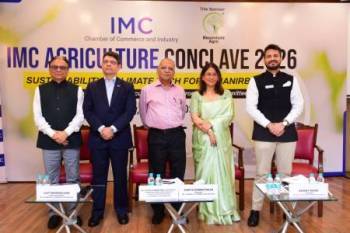


MUMBAI, 15 May 2026: At the IMC Agriculture Conclave 2026, industry experts and policymakers emphasised that technology adoption, climate-smart agriculture and farmer collectivisation will be critical for achieving self-reliance in India’s food security ecosystem.
Organised by the IMC Chamber of Commerce and Industry under the theme “Sustainability & Climate Tech for Atmanirbharta”, the conclave focused on strengthening India’s agricultural resilience amid global supply chain disruptions and climate-related risks.
Farmer collectivisation key to reforms
Sudhir Kumar Goel said India’s agriculture sector employs nearly 46 per cent of the population but contributes only around 18 per cent to GDP, highlighting structural challenges faced by small and marginal farmers.
He noted that most farmers lack the resources needed to adopt modern technologies and advanced farming practices independently.
“Collectivisation of farmers, rather than land consolidation, is key to accelerating agricultural reforms,” Goel said, adding that farmer groups can pool resources to deploy technologies such as IoT and AI for improving productivity and farm incomes.
Food security concerns amid global uncertainty
Sunita Ramnathkar said agriculture remains the backbone of India’s economy but rising import dependence on key food commodities and climate challenges have intensified the need for sustainable agricultural systems.
Aashay Doshi warned that geopolitical tensions in West Asia and disruptions around the Hormuz Strait could create fertiliser shortages and threaten India’s food security.
India consumes over 60 million tonnes of chemical fertilisers annually, with nearly half dependent on imports. LNG imports also remain crucial for domestic fertiliser production.
Push for bio-fertilisers and sustainable agriculture
Goel advocated greater promotion of bio-fertilisers as India seeks to reduce import dependency and strengthen agricultural sustainability.
India currently imports nearly $18 billion worth of edible oils annually, meeting over 60 per cent of domestic demand through imports of around 16 million tonnes every year.
Similarly, the country imports 5–7 million tonnes of pulses annually to bridge nearly 20 per cent of domestic consumption requirements.
Speakers at the conclave stressed that achieving “Atmanirbharta” in agriculture requires not only higher productivity, but also environmentally sustainable and technologically advanced farming systems that improve farmer incomes while reducing external dependencies.