





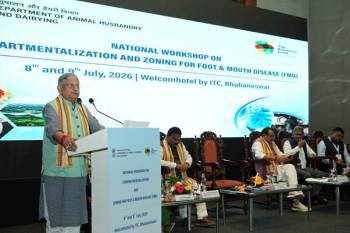


BHUBANESWAR, 17 July 2026: The Department of Animal Husbandry and Dairying (DAHD), Ministry of Fisheries, Animal Husbandry and Dairying, has launched a renewed push towards achieving India's goal of becoming Foot and Mouth Disease (FMD)-free by 2030 through a national workshop on compartmentalisation and zoning held in Bhubaneswar, Odisha.
The two-day National Workshop on Compartmentalization and Zoning for Foot & Mouth Disease brought together policymakers, veterinary experts, scientists and state officials to discuss strategies for strengthening India's animal health system, enhancing disease surveillance and facilitating safe domestic and international trade in livestock and livestock products.
The workshop was inaugurated by Union Minister for Fisheries, Animal Husbandry and Dairying Rajiv Ranjan Singh (Lalan Singh) in the presence of Minister of State Prof. S.P. Singh Baghel, Odisha Fisheries and Animal Resources Development Minister Gokulananda Mallik, DAHD Secretary Naresh Pal Gangwar, Additional Secretaries Varsha Joshi and Rama Shankar Sinha, and Animal Husbandry Commissioner Dr. Naveena B. Maheswarappa.
A major highlight of the inaugural session was the launch of four digital initiatives aimed at improving livestock health services, dairy governance and veterinary capacity building. The Union Minister launched the Rate My Laboratory App, Dairy Vikas Portal, and Vidyapeeth Portal, besides releasing the Standard Operating Procedure (SOP) for Prevention and Control of Mastitis in Dairy Animals.
The Rate My Laboratory App has been developed to strengthen veterinary diagnostic services through real-time user feedback, while the Dairy Vikas Portal will enable real-time monitoring of milk collection infrastructure, procurement and utilisation across the country. The Vidyapeeth Portal will digitise the management of Artificial Insemination Training Institutes through QR-based certification and MIS monitoring. The newly released mastitis SOP aims to promote scientific dairy management practices and improve milk quality.
Addressing the gathering, Union Minister Rajiv Ranjan Singh highlighted the growing importance of the livestock sector, which contributes nearly 31% of agriculture's Gross Value Added (GVA) and around 5.5% of India's total GVA.
He said India has made significant progress in controlling Foot and Mouth Disease through sustained vaccination drives under the National Animal Disease Control Programme (NADCP), one of the world's largest livestock vaccination campaigns.
The Minister noted that more than 1.4 billion FMD vaccine doses have been administered so far, while NSP positivity has declined from 16.6% in 2022 to 7.8% in 2026, indicating improved disease control. He also pointed out that no Asia-1 serotype case has been reported in the last three years, and India currently has an annual production capacity of 116 crore FMD vaccine doses.
To accelerate eradication efforts, the government has identified nine priority states for developing FMD-free zones and disease-free compartments using a decentralised approach aligned with international standards of the World Organisation for Animal Health (WOAH).
Minister of State Prof. S.P. Singh Baghel said the livestock sector supports the livelihoods of more than eight crore rural families, particularly women, making disease control critical for rural incomes and food security.
Odisha Minister Gokulananda Mallik stressed that sustained vaccination, robust surveillance, improved biosecurity and stronger veterinary infrastructure would be essential to achieving internationally recognised FMD-free status by 2030.
DAHD Secretary Naresh Pal Gangwar highlighted the importance of compartmentalisation and zoning in strengthening India's disease control framework and improving export opportunities for livestock products.
The workshop also focused on strengthening preparedness for possible El Niño-induced fodder shortages. Addressing the technical session, Additional Secretary Varsha Joshi urged states to prepare district-wise fodder action plans, operationalise Fodder Task Forces and promote silage production to ensure year-round feed availability for livestock.
The first technical session covered WOAH standards for establishing FMD-free zones and compartments, implementation of the Support to States/UTs for Capital Investment (SASCI) Scheme and strengthening animal health infrastructure.
The second day of the workshop will focus on differential disease control strategies for states and Union Territories, implementation roadmaps for FMD-free zones, negative marker vaccines, emerging SAT serotype threats and coordinated planning among stakeholders.
Officials said the workshop is expected to strengthen Centre-State coordination, improve disease surveillance, facilitate safe livestock trade and provide a comprehensive roadmap for achieving India's target of becoming FMD-free by 2030.