





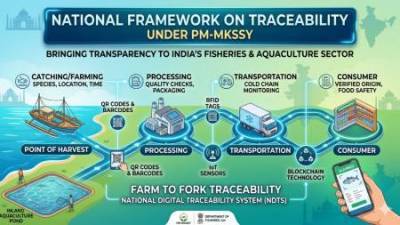


NEW DELHI, 22 July 2026: The Centre has launched a National Framework on Traceability in Fisheries and Aquaculture, 2025, aimed at creating a digital traceability system across the seafood value chain to strengthen food safety, improve transparency and enhance India's seafood exports.
In a written reply to the Rajya Sabha, Union Fisheries, Animal Husbandry and Dairying Minister Rajiv Ranjan Singh (Lalan Singh) said the framework will help ensure compliance with domestic and international standards while improving consumer confidence and market access for Indian seafood products.
The government said the traceability system will be implemented in a phased, technology-driven manner under the supervision of a National Level Governance Committee (NLGC) and an Adoption Committee, which will facilitate the rollout of an IT-based national traceability platform for fisheries and aquaculture stakeholders.
INR 21,394 crore approved under PMMSY
To strengthen seafood export infrastructure, the Department of Fisheries has approved projects worth INR 21,394.88 crore, including a Central share of INR 9,510.89 crore, under the Pradhan Mantri Matsya Sampada Yojana (PMMSY).
Additionally, under the Fisheries and Aquaculture Infrastructure Development Fund (FIDF), 18 projects worth INR 345.89 crore have been supported, primarily for expanding and modernising fish processing plants.
The Marine Products Export Development Authority (MPEDA) has also provided INR 118.10 crore in financial assistance to 89 seafood processing units between 2021-22 and 2025-26 under its Technology Development for Specific Value-Added Marine Products (TDSVMP) scheme. The programme supports modern fish processing facilities, cold storage, automated processing equipment and value-added seafood products.
Stronger food safety and export compliance
The Export Inspection Council (EIC), under the Department of Commerce, continues to oversee quality control and inspection of marine product exports. It conducts regular training on Food Safety Management Systems (FSMS) and mandates testing of aquaculture shrimp for banned antibiotics before export certification.
MPEDA, together with the Coastal Aquaculture Authority (CAA) and EIC, is implementing the National Residue Control Plan (NRCP) to strengthen residue monitoring, traceability and compliance with international food safety standards.
Focus on sustainable and export-oriented aquaculture
The Department of Fisheries is also promoting the cultivation of export-oriented species such as Scampi, Mud Crab, Asian Seabass and Cobia, alongside advanced technologies including Recirculating Aquaculture Systems (RAS) and Biofloc.
To support sustainable fisheries, the government is implementing the Marine Mammal Stock Assessment Project and promoting the installation of Turtle Excluder Devices (TEDs) on shrimp trawlers under PMMSY.
The Coastal Aquaculture Authority has also updated the list of prohibited pharmacologically active substances and antimicrobial agents under the Coastal Aquaculture Authority Rules, 2024, to ensure Indian seafood continues to meet global food safety requirements.