





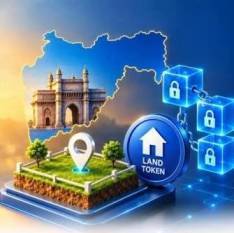


MUMBAI, 14 September 2026: Maharashtra is preparing a legal framework to enable the tokenisation of land and other immovable assets, potentially opening a new chapter for farmland, real estate and real-world assets in India.
Maharashtra is moving closer to creating a dedicated legal framework for land tokenisation, with Chief Minister Devendra Fadnavis saying the state aims to become the first in India to introduce legislation governing the use of digital tokens to represent land and other immovable assets.
The proposed framework is being developed under the Maharashtra Digitisation and Exchange of Land Token Assets Act, or DELTA Act. The government is reportedly targeting the introduction of the framework within the next four to five months, although the legislation has not yet been enacted.
What is land tokenisation?
Land tokenisation involves creating digital representations, or tokens, linked to an underlying physical asset. In the proposed Maharashtra framework, blockchain technology could be used to create a digital representation of land ownership or an interest in an immovable asset.
The concept could eventually have applications across agricultural land, farmland, residential property, commercial real estate and other real-world assets, depending on how the final legislation defines eligible assets and rights.
The objective is not simply to put land records on a blockchain. The larger ambition is to create a legally recognised system through which digital tokens can represent underlying property interests and potentially participate in transactions or financing.
How could tokenised farmland work?
For farmland tokenisation, a digital token could potentially represent a legally defined interest connected to a particular parcel of agricultural land.
However, tokenisation would not automatically mean that anyone could freely buy and sell fractional pieces of farmland. Agricultural land ownership in Maharashtra is subject to existing land laws, eligibility restrictions and transfer requirements.
The final DELTA framework will therefore be critical in determining what a token represents, who can hold it, how ownership is verified and how token transfers interact with existing land records and registration systems.
Why does Maharashtra want to tokenise land?
The state government sees digitisation and tokenisation as a way to make property transactions more transparent and efficient while unlocking the economic value of assets.
Fadnavis has said the proposed system could make transactions involving land faster and could also help property owners use their assets more efficiently, including potentially for financing and loans.
For landowners, a trusted digital system could potentially reduce friction around verification, documentation and transfer. For financial institutions, better digital records could eventually make property-related due diligence and collateral assessment more efficient.
Will blockchain replace traditional land records?
Not necessarily.
The proposed system appears intended to work alongside the existing legal and administrative framework rather than simply replacing conventional land records with blockchain tokens.
This distinction is important because a blockchain token by itself does not automatically create legal ownership of real estate. The final legislation will need to establish the legal connection between an on-chain token and the underlying property rights.
SEBI, RBI and financial institutions could play a role
Maharashtra's plans also raise questions involving India's financial-market and banking regulators.
Reports indicate that the state is seeking inputs from institutions and experts, including SEBI, NSE and BSE, while coordination with the Centre and financial institutions is also expected to be important.
The regulatory architecture becomes particularly important if tokenised land is eventually used for investment, lending, fractional ownership or other financial activities.
What happens next?
The immediate focus is on developing the legal and regulatory framework. Recommendations for the proposed legislation have reportedly reached an executive committee, with further work required before the government can introduce the law.
If implemented, Maharashtra's land tokenisation law could make the state an important testing ground for India's emerging real-world asset (RWA) tokenisation sector.
For farmers, landowners, developers and financial institutions, however, the key question will be whether tokenisation delivers genuine legal and financial utility—not simply a digital version of an existing land document.
The final DELTA Act, once introduced, will determine whether Maharashtra's land tokenisation experiment becomes a practical model for farmland tokenisation, real estate tokenisation and blockchain-based property markets in India.
By Jagdish Kumar